In coastal ecosystems, water exchange plays an extremely important role. Those coastal areas with rapid and active water exchange usually have good self-purification capability, despite of possible loading of various contaminants and pollutants.
Even in the case of no significant local sources of pollutants in the adjacent land-regions,
due to slow water exchange coastal eutrophication is building up in an increased rate. Consequently, marine environment is becoming worse.
Water exchange in coastal areas can be studied by box, parcel-tracking, and dispersion models, with dispersion model being characterized by major physical processes (i.e., advection and diffusion).
The Adriatic Sea, having unique characteristics (elongated shape, almost land locked position between the mountains situated on Balkan and Italian Peninsulas and relatively shallow waters, especially in northern part) is especially vulnerable to water pollution.
The Adriatic coast is very attractive as a site for various resorts and as vacation destination.
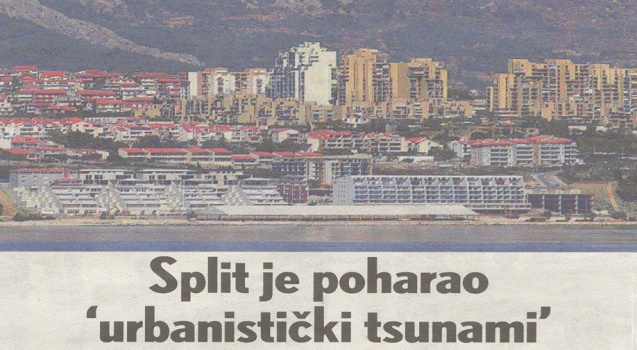
Consequently, rapid urbanization causes great pressure to the marine ecosystem as can be seen from the picture below.
Namely, more people in the coastal zones means more pollution of coastal waters, more pressure on nearby
natural resources as flow fields favour bringing in and accumulation of pollutants, which consequently
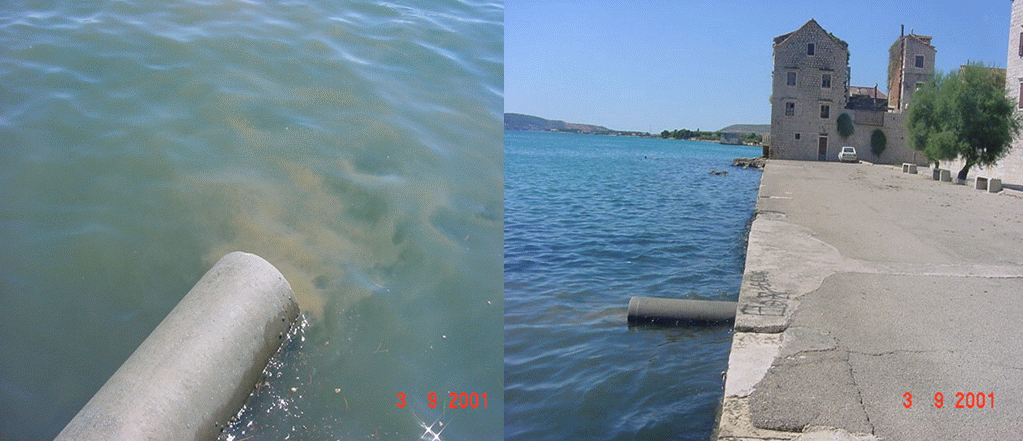
deteriorate water quality as can be clearly seen from the picture below.
In addition, various economic activities e.g., maritime transport of various goods, including oil, pose additional threat to the whole ecosystem. Recently,
Družba Adria Project, planned for the export of crude oil from the Russian Federation through Belarus, Ukraine, Slovakia, Hungary and Croatia through the Omišalj Port on the island of Krk, with quantities of several millions of tonnes per year caused considerable interest and disapproval in public regarding not only possible oil transporting tanker accidents, but also the problem of discharging ballast waters.
The basic information about the project can be found here
However, for the overall impact assessment it is crucial to know the time needed for the exchange of the entire Adriatic Sea water with the rest of Mediterranean, which quantifies the self-purification capability of the Adriatic sea.
The assessment of the Adriatic sea water turnover time using fallout can be done either by measuring
mass transport of waters on the Strait of Otranto or by mathematicel modelling
using data on various tracer studies, including the radioactive ones.
Therefore, radionuclides are of interest to marine scientists for two primary reasons:
a) as potential contaminants of the ocean biosphere and
b) as radioactive tracers for studies of water masses, sediment movements and various other parameters.
The dominant route for the introduction of artificial radionuclides into the environment, until the nuclear accident in Chernobyl on 26 April 1986, has been the radioactive fallout resulting from the atmospheric nuclear weapon tests.
The mean value of literature data for the Adriatic Sea water turnover time (compiled in first two articles
available below, including the result obtained by modelling turnover time using fallout 90Sr as a radioactive tracer) is:
2.61 ± 1.35 years, the median value being 2.70 years.
Some Scientific Articles
Franic Z.
Estimation of the Adriatic sea water turnover time using fallout 90Sr as a radioactive tracer
Journal of Marine Systems 57:1-12, 2005. Abstract | JMS: Complete Article
| Arxiv.org: Complete Article
Franic Z.
Sensitivity Analysis of the Model for Estimation of the Adriatic Sea Water Turnover Time Using fallout 90Sr as a Rradioactive Tracer (In Croatian) Proceedings of the 6th Symposium of the Croatian Radiation Protection Association, April 2005.
Complete Article
Franic Z., Lokobauer N. and Marovic G.
Radioactive contamination of cistern waters along the Croatian coast of the Adriatic sea by 90Sr.
Health Physics. 77(1):62-6, 1999 Jul. 10376543
Abstract | Complete Article
Franic Z. and Lokobauer N. 90Sr and 137Cs in pilchards from the Adriatic Sea.
Arhiv Za Higijenu Rada i Toksikologiju. 44(4):293-301, 1993 Dec. 8192602
Franic Z. and Bauman A.
Radioactive contamination of the Adriatic Sea by 90Sr and 137Cs.
Health Physics. 64(2):162-9, 1993 Feb. Complete Article
Research Reports
Franic Z. and Bauman A.
Collection and Evaluation of Marine Radioactivity Data in the Adriatic Sea
Report of the IAEA Research Contract No. 302-K4-CRO-8844, B5-CRO-24175 Report